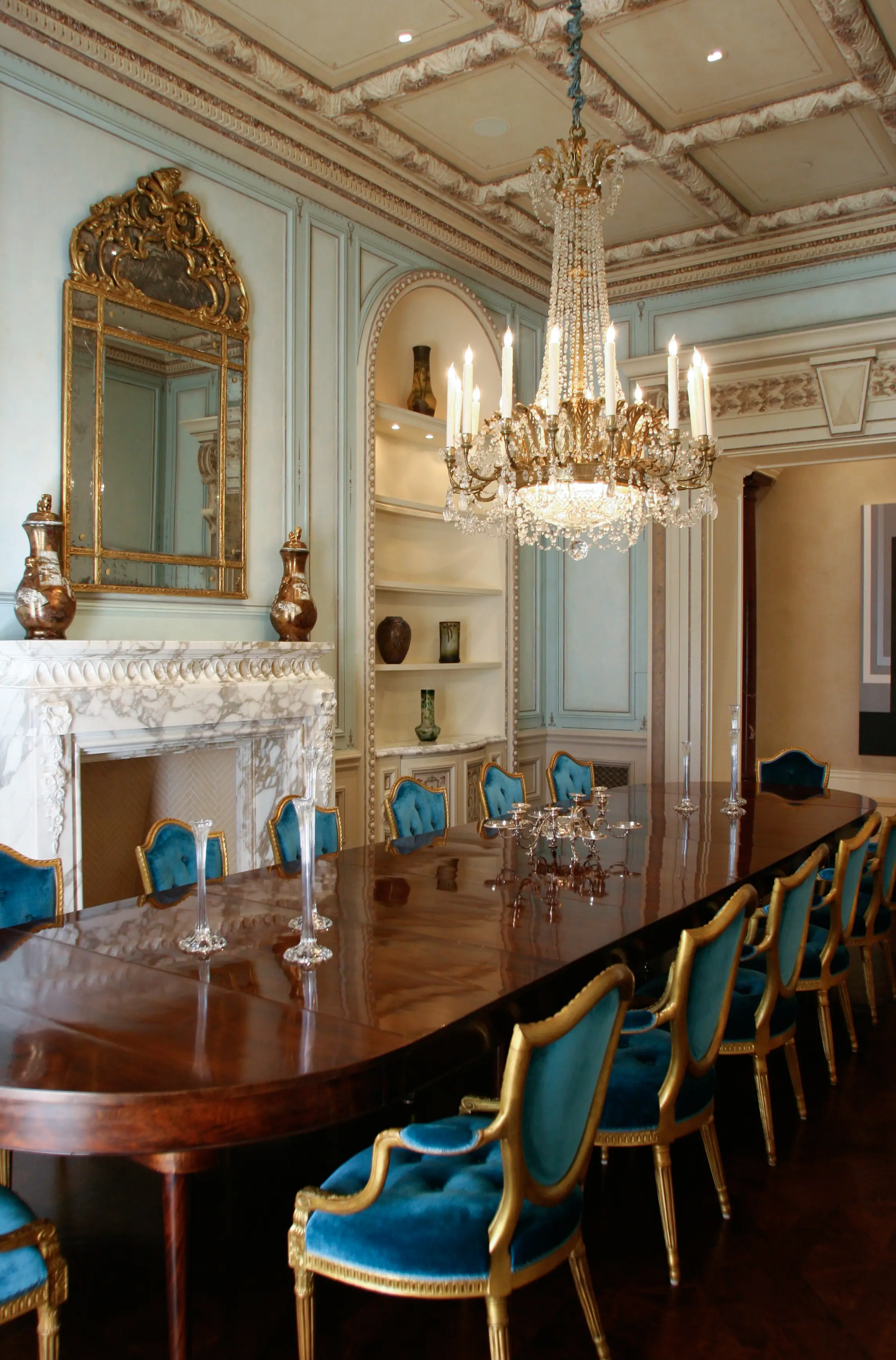
Faux finishes, faux bois & faux marble
Marbling, wood graining, metal patination and custom wood treatments — painted by hand and matched to real material, sample in hand, on site.
Faux finishing has a reputation problem, earned in the 1990s by a great deal of rag-rolled sponge work. Done properly it is one of the oldest and most technically demanding parts of the trade: the imitation of one material in another, convincingly enough that the eye accepts it.
Real marbling is not a pattern. It is the depiction of a specific stone, with its own bedding, veining logic and translucency, built in glazes so that light appears to go into the surface. Real wood graining follows the actual anatomy of a species — how quarter-sawn oak differs from flat-sawn, where the figure runs, how the grain behaves around a joint.
We work from samples of the actual material wherever possible, and we produce a sample panel for approval before touching the room.
Faux Finishes in place
How the work is done
Every stage below exists because skipping it shows up later, usually expensively.
- 01
Material reference
We start from the real thing — a stone offcut, a timber sample, the existing joinery. Imitating a photograph of marble produces a picture of a photograph.
- 02
Sample panel
A full sample is produced and viewed in the room, in its own light, alongside whatever it has to match. Nothing starts until it is signed off.
- 03
Ground
The ground colour and sheen are established. In marbling the ground is doing most of the work of making the finish look translucent.
- 04
Body and veining
Successive glazes build the body of the stone or the figure of the timber. Veining is drawn last and sparingly — over-veining is the commonest failure in marbling.
- 05
Softening and glazing
Edges are softened so nothing sits on top of the surface, and the whole is unified under a final glaze.
- 06
Finish
Polished, satin or matte to match the material being imitated. A polished marble finish and a limestone finish are different at this stage, not earlier.
Faux marble
Good marbling starts with a decision about which marble. Carrara, Breccia, Verde Antico and Sienna do not behave alike, and painting a generic "marble" produces something that reads as fake from across the room.
It is built in thin glazes over a carefully chosen ground so that the finish has apparent translucency, and veined last — always less than instinct suggests. The test is whether it holds up beside the real stone in the same room, which is exactly where clients put it.
Faux bois and custom wood treatments
Wood graining follows anatomy. Where the figure runs, how it changes across a quarter-sawn versus flat-sawn board, how it interrupts at a joint — those are the details that make graining convincing, and they are why grained work looks right on doors and panelling and wrong when applied as a texture.
Alongside graining we do custom wood treatments on real timber: tinted and layered stains, limed and cerused finishes, ebonising, and colour-matching new joinery to existing period woodwork.
Metal patinas
Verdigris, bronze, oxidised steel and rust can all be produced on any substrate, which is useful when a specified metal is too heavy, too expensive or too slow to obtain.
These finishes are also the right answer when new metalwork has to match existing aged metal — a patina develops over decades and cannot be waited for.
Common questions
What is faux bois?
Faux bois is French for "false wood" — the hand-painted imitation of wood grain on another surface. Traditionally used to bring cheaper timber or non-timber surfaces up to the appearance of a finer species.
Will faux marble actually look like marble?
Properly executed, yes — including next to the real thing, which is where it usually ends up. It depends entirely on working from a real reference and on restraint with the veining.
Do you provide samples first?
Always. A sample panel is produced and approved in the room’s own light before any work begins.
Can you match existing decorative finishes?
Yes. Matching and repairing existing glazed, grained and patinated finishes is a large part of what we do, particularly in period houses.
Projects using this work
Related services
Venetian Plaster & Lime Finishes
Burnished lime plaster, marmorino and polished stucco applied by hand in multiple troweled coats.
Decorative Painting, Chinoiserie & Grisaille
Hand-painted ornament, stencilled borders, chinoiserie panels and tonal grisaille for period interiors.
Gold Leaf & Gilding
Water and oil gilding in gold, silver and composition leaf — ceilings, ornament, signage and furniture.
Tell us about the room.
Every commission begins with a conversation about the space, the light and what it needs to do. Consultation and site assessment are available for projects across Greater Los Angeles.