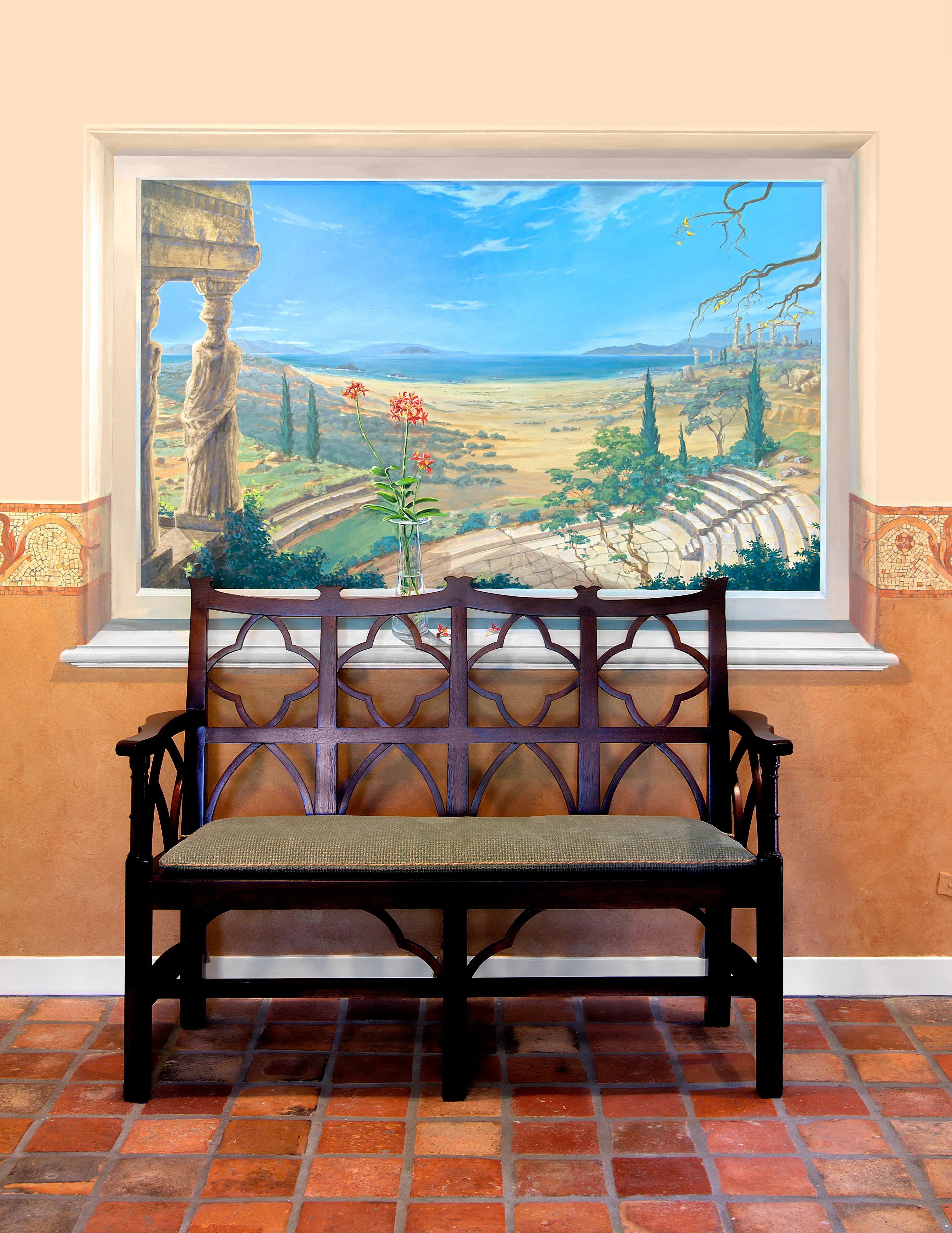
Venetian plaster & lime finishes
Burnished lime plaster, marmorino and polished stucco — a material rather than a coating, laid in thin successive coats and polished to a depth that paint cannot imitate.
Venetian plaster is slaked lime putty loaded with marble dust and pigment, applied with a steel trowel in very thin coats and burnished as it sets. Because the colour is in the material rather than on top of it, the surface has real depth — light enters it, scatters and comes back, which is why a plastered wall changes through the day and a painted one does not.
It is also an old and remarkably durable technology. Lime plaster is alkaline, vapour-permeable and self-healing in fine cracks; Roman and Venetian examples are still on the wall. The synthetic products sold under the same name are neither, and they behave differently within a few years.
We apply genuine lime finishes across the full range — high-polish Veneziano, textured marmorino, tadelakt-style burnished work for wet rooms, and tinted lime washes for larger surfaces where a polish would be too much.
Venetian Plaster in place
How the work is done
Every stage below exists because skipping it shows up later, usually expensively.
- 01
Substrate assessment
Lime is unforgiving of movement and of the wrong ground. The substrate is checked for flatness, soundness and suction, and prepared accordingly.
- 02
Base coat and grounding
A levelling and grounding coat establishes a uniform, correctly absorbent surface. Skipping this shows up as blotching in the finish coats and cannot be corrected later.
- 03
First plaster coat
The first thin coat is laid with a trowel and left to take up. It builds the body of the finish and establishes the colour field.
- 04
Successive coats
Two to five further coats, each thinner than the last, are laid and knocked back. The number of coats — not the product — is what produces depth.
- 05
Burnishing
The final coat is compressed and polished with the trowel as it sets. Timing is everything: too early and it will not take a polish, too late and the surface will burn.
- 06
Sealing and waxing
Where required — wet areas, high-traffic walls — the finish is sealed or waxed. Many interiors are better left unsealed so the lime can continue to breathe.
What makes it worth the cost
Two things: depth and life. A polished lime wall is translucent for a fraction of a millimetre, so light goes in before it comes back out. That is the entire visual difference, and no paint or wallpaper reproduces it because they are opaque at the surface.
The second is longevity. Lime carbonates and continues to harden for years. Properly applied over a sound substrate it outlasts every painted finish in the building, and it can be repaired and re-polished rather than stripped and redone.
Where it works — and where it does not
Lime finishes are excellent in entry halls, stair wells, dining rooms, bathrooms, vaulted and curved surfaces, and anywhere raking light will be doing the work. They are superb over masonry and traditional plaster.
They are a poor choice over substrates that move — unbraced timber-frame partitions, recent drywall installations still settling, or anything with active moisture ingress. In those cases we will tell you so and propose something else rather than take the job and watch it crack.
Common questions
How much does Venetian plaster cost in Los Angeles?
Genuine burnished lime plaster typically runs $12–$35 per square foot depending on coat count, level of polish, surface geometry and access. Curved or vaulted work sits at the top of that range.
Is Venetian plaster suitable for bathrooms?
Yes. Lime is alkaline and vapour-permeable, which makes it well suited to damp rooms — it has been used in bathhouses for two thousand years. Direct-splash zones need the appropriate burnished and sealed specification.
How is it different from a textured paint?
Textured paint is a coating that sits on the wall and imitates depth with pigment and aggregate. Venetian plaster is a mineral material that becomes the wall surface, and its depth is real rather than depicted.
Can existing Venetian plaster be repaired?
Yes. Because it is a material rather than a film, damage is worked in and re-polished. Matching an aged burnished surface is skilled work but entirely possible.
Do you provide sample panels?
Always, for anything larger than a small room. Lime finishes must be approved in the room’s own light, not from a photograph.
Projects using this work
Related services
Faux Finishes, Faux Bois & Faux Marble
Faux marble, faux bois graining, metallic patinas and custom wood treatments matched to existing material.
Decorative Painting, Chinoiserie & Grisaille
Hand-painted ornament, stencilled borders, chinoiserie panels and tonal grisaille for period interiors.
Gold Leaf & Gilding
Water and oil gilding in gold, silver and composition leaf — ceilings, ornament, signage and furniture.
Tell us about the room.
Every commission begins with a conversation about the space, the light and what it needs to do. Consultation and site assessment are available for projects across Greater Los Angeles.