What is trompe l'oeil painting?
The term means 'deceive the eye'. What actually creates the deception is not draughtsmanship — it is shadow, viewpoint and restraint.
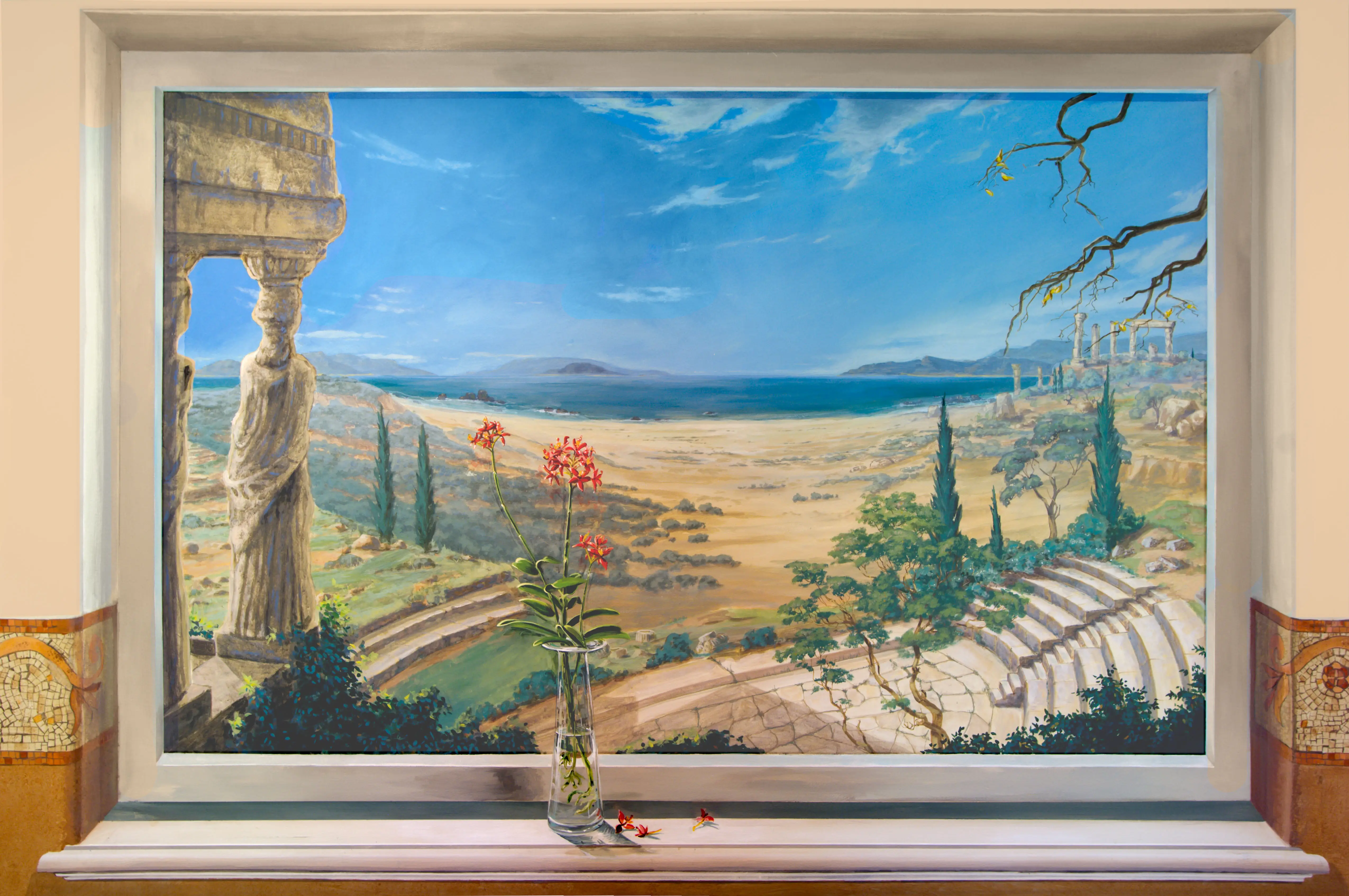
Trompe l’oeil is French for “deceives the eye”. It describes painting intended to be mistaken for a real object, opening or architectural feature — not recognised as a picture of one and admired for its likeness, but genuinely, if briefly, believed.
That distinction matters, because it changes what the painter is actually solving. A very fine realist painting of a window is still a painting of a window. A trompe l’oeil window is a piece of architecture that happens to be made of paint.
The deception is made of shadow
Ask most people what makes trompe l’oeil work and they will say detail, or skill. Both are wrong.
What makes it work is that the painted object’s shadows agree with the real light in the room.
Consider a painted window. For the eye to accept it:
- The reveal must darken on the side turned away from the room’s actual light source.
- The sill must cast a shadow onto the wall below it at the same angle the real windows nearby are casting.
- The frame must catch light on its top edge and lose it on its underside.
- The horizon in the view beyond must sit where a real horizon would sit for someone standing at normal eye level at that spot in the room.
Get those right and quite modest painting will hold. Get any one of them wrong — put the shadow on the wrong side of the frame — and no amount of virtuosity in the landscape beyond will rescue it. The eye catches the contradiction instantly, even in viewers who could not say what is wrong.
This is why the work begins with measurement rather than drawing. Where are the light sources, natural and artificial? At what height is the viewer’s eye? From what direction do they approach, and where do they stop? Everything else follows from those answers.
A very old idea
The technique is genuinely ancient. Pliny tells the story of Zeuxis and Parrhasius: Zeuxis painted grapes so convincingly that birds flew down to peck at them, then asked Parrhasius to draw back the curtain covering his rival’s work — and found the curtain was the painting. The anecdote is almost certainly embroidered, but it identifies the right criterion. Zeuxis fooled a bird. Parrhasius fooled a painter.
Roman wall painting at Pompeii and Herculaneum is full of illusionistic architecture: painted columns, painted openings onto painted gardens, painted marble on walls that were plaster. Renaissance and Baroque ceiling painting — Mantegna’s oculus at Mantua, Pozzo’s dome at Sant’Ignazio — pushed the same logic upward, opening solid vaults onto painted sky.
The domestic tradition that most modern work descends from is later: eighteenth and nineteenth century painted panelling, false doors, painted niches with painted objects in them, and the quodlibet — a painted board with letters and papers apparently tucked under a real ribbon.
Where it earns its place today
Trompe l’oeil is at its best solving a specific architectural problem rather than decorating a wall that is already fine.
Good candidates:
- A windowless room. Powder rooms, interior baths, basement studies. A painted opening gives the eye somewhere to go.
- A dead end. The blank wall at the top of a stair, or at the end of a corridor, where the architecture stops without resolving.
- A missing feature. A chimney breast with no chimneypiece; panelling that stops halfway; a room that wants a niche it cannot structurally have.
- A continuation. Extending a real moulding, dado or cornice run across a section where it was never installed.
Poor candidates are rooms where the viewer will approach from many angles at once, or stand right up against the wall. A single-viewpoint construction cannot survive both conditions, and pretending otherwise produces the kind of half-convincing work that gives the discipline its slightly dated reputation.
In those rooms the better answer is painted architecture — niches, panelling, mouldings, grisaille relief — which reads correctly from anywhere because it lies flat against the wall plane rather than pretending to open through it.
Restraint is the technique
The most common failure in this work is doing too much.
Every element added to an illusion is another chance for something to disagree with the light. And a viewer only needs to catch one error to stop believing all of it — belief is not partial. This is why the strongest trompe l’oeil is usually quiet: one opening, one convincing object, and a great deal of care spent on the edges nobody consciously examines.
It is also why the last object added is often the one that does the work. In a painted window we made for a house in Southern California, the view — coastline, cypress, a ruined amphitheatre — is not what makes people reach out and touch the wall. It is a glass vase of lilies on the painted sill, with two blossoms fallen beside it.
Two fallen blossoms imply that something has moved. And a surface where something has moved is not an image. It is a place.
Le Grande Studios has been painting illusionistic work in Los Angeles for thirty years. See more trompe l’oeil, or talk to the studio about a room.